
Posts
What If the Secret to Raising Resilient Kids Has Been Right in Front of You?
By Dr. Roderick Logan, DPTh, DAAETS Website: www.rodericklogan.com
As fathers, we carry an immense responsibility. We are not just present in our children's lives—we are the architects of their future resilience. Our role is crucial, and the question that keeps many of us awake at night is not whether we love our children, but whether they truly feel that love in ways that will sustain them long after we are gone.
The answer to this question lies in a powerful framework I call I Was Loved. This framework holds particular power for fathers who want to break cycles, build legacies, and raise sons and daughters who know, without question, that they were cherished. It's a tool that empowers us to make a lasting impact on our children's lives.
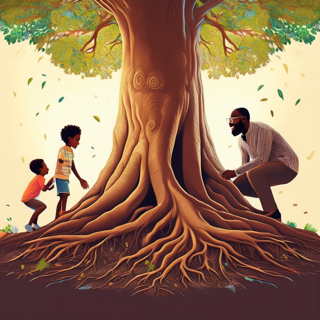
Think of fatherhood as roots. Not the visible parts of the tree—not the branches that sway in the wind or the leaves that catch the light. Roots. The hidden network beneath the surface that anchors the tree through storms, draws nourishment from deep sources, and determines whether the tree will stand or fall when adversity comes. Our children are the visible growth. However, we are the roots. Moreover, the deeper, stronger, and more intentional our presence, the more resilient they become.
This metaphor is not merely poetic—it reflects the biological reality of how secure attachment literally shapes brain architecture. Just as roots establish the foundation for everything a tree becomes, our consistent, loving presence establishes the neural pathways that determine how our children will navigate relationships, regulate emotions, and respond to adversity for the rest of their lives. The root system we cultivate in our children's early years becomes the unseen infrastructure of their adult well-being.
Meaning: Why This Moment Demands Our Attention
Our children are facing unprecedented mental health challenges. According to the Centers for Disease Control and Prevention, nearly 20% of children aged 3-17 have a diagnosed mental, emotional, or behavioral disorder. Anxiety and depression rates among adolescents have increased by more than 50% over the past decade. Suicide has become the second leading cause of death among young people aged 10-24. As fathers, we witness our children navigating social pressures and digital influences that complicate the parent-child connection in ways previous generations never encountered.
The statistics are sobering, but they do not tell the whole story. Behind each percentage point are real children—our children—who are struggling to make sense of a world that often feels chaotic, unmanageable, and devoid of meaning. They are growing up in an era of unprecedented access to information, yet profound disconnection from stable relationships. They face academic pressures that. Previous generations would have considered it unreasonable, as social comparison is amplified by constant digital exposure and a cultural narrative that too often emphasizes performance over personhood.
However, research consistently demonstrates that children who genuinely feel loved develop resilience that protects them against these very challenges. The science is clear and compelling. Secure attachment creates neural pathways that support emotional regulation, healthy relationships, and adaptive coping throughout life. Studies from developmental psychology, neuroscience, and attachment research converge on a singular truth: children who experience consistent, attuned, loving presence from their caregivers develop what researchers call "earned security"—an internal working model of relationships that serves as a protective factor against mental health challenges, substance abuse, and maladaptive coping strategies.
This is where salutogenesis becomes essential to our understanding. Coined by medical sociologist Aaron Antonovsky, salutogenesis represents a paradigm shift in how we think about health and resilience. Rather than focusing solely on what causes disease and dysfunction (pathogenesis), salutogenesis asks what creates health and resilience. Antonovsky identified three core components that contribute to what he called a "sense of coherence": comprehensibility (the ability to make sense of one's experiences), manageability (the perception that one has resources to cope with challenges), and meaningfulness (the conviction that life's demands are worthy of investment and engagement).
As fathers, we have the profound opportunity—and responsibility—to cultivate these three dimensions in our children's lives. When we help our children understand their emotions and experiences, we build comprehension. When we equip them with coping strategies and demonstrate that challenges can be navigated, we build manageability. When we connect their lives to larger purposes and show them that their existence matters, we build meaningfulness.
The meaning is clear: our children need us to be present, intentional, and rooted. Not perfect, but present. Not controlling, but connected. The accumulation of attentive, loving moments—moments that communicate to our children that they matter, that they are seen, and that they are valued—becomes the root system that sustains them through every season of life. This is not about grand gestures or exceptional parenting. This is about the daily, often mundane choices to show up, pay attention, and communicate love in ways our children can receive.
Purpose: The Five Pillars That Anchor Our Children
The I Was Loved approach rests on five foundational components that transform ordinary fathering into legacy-building presence. These are not abstract ideals but concrete practices—the root structures we intentionally cultivate. Each pillar represents a different dimension of secure attachment and contributes uniquely to our children's developing sense of coherence.
Consistent presence and attention.
Your children need to know you are there—not just physically occupying space, but mentally and emotionally engaged. Presence means more than proximity. It means turning toward your child when they speak. It means putting down the phone, making eye contact, and listening without formulating your response while they are still talking. It means noticing the small moments—the disappointment flickering across their face, the excitement barely contained, the question they are almost afraid to ask.
Research in attachment theory emphasizes the importance of parental availability and responsiveness. Children develop secure attachment when their primary caregivers consistently respond to their needs with sensitivity and attunement. This does not mean we must be available every moment of every day. It means that when we are with our children, we are truly with them. Consider the father who instituted "no phones at dinner" and discovered that his teenage daughter began sharing struggles she had kept hidden for months. That simple boundary created space for genuine connection. Like roots that must consistently draw water from the soil, our presence must be reliable and nourishing.
Verbal affirmation and positive communication.
Words create worlds. The internal narrative your children develop about themselves—their worth, their capabilities, their lovability—is shaped profoundly by the words they hear from you. Say the words. "I am proud of you." "I see how hard you worked on that." "I love spending time with you." "You have good judgment." "I trust you." These statements create internal narratives that children carry into adulthood.
However, not all affirmations are equally powerful. Generic praise ("Good job!") has less impact than specific observations that communicate genuine attention and understanding. One father makes it a practice to tell each child one specific thing he noticed about them every day—not generic praise, but genuine observation. "I saw how patient you were with your little brother when he knocked over your blocks. That showed real maturity." This kind of specific affirmation accomplishes multiple goals: it demonstrates that the father is paying attention, it names character qualities rather than just outcomes, and it helps the child develop self-awareness about their own strengths.
These words become the nutrients that feed their sense of worth. When children internalize positive, accurate messages about themselves, they develop resilience against the inevitable criticism and rejection they will face in the broader world.
Physical affection and appropriate touch.
Hugs, high-fives, and a hand on the shoulder—these convey safety and belonging in ways that words cannot fully capture. Physical touch releases oxytocin, the bonding hormone that reduces stress and promotes feelings of security. Do not let cultural messages about masculinity rob your children of this essential need. The myth that boys, especially as they approach adolescence, do not need physical affection from their fathers is precisely that—a myth, and a damaging one.
Even teenage sons who seem to resist still need that hand on the shoulder, that side hug after a challenging game, that reassuring touch that says, "I am here and you are safe." Physical affection literally shapes brain development and stress regulation, anchoring children in a sense of felt security. Neuroscience research demonstrates that children who receive consistent, appropriate physical affection from their caregivers develop more robust stress regulation systems and demonstrate greater emotional resilience in the face of adversity.
Establishing healthy boundaries with compassion.
Love does not mean permissiveness. Children need structure, but it must be delivered with respect and explanation. One of the most damaging misconceptions about positive parenting is the belief that it requires us to avoid setting limits or to accept all behavior without correction. Nothing could be further from the truth. Children desperately need boundaries—they create a sense of safety and predictability in a world that often feels chaotic.
The question is not whether to set boundaries but how. Discipline that maintains dignity builds resilience; shame-based correction damages it. When a father says, "I am saying no because I love you and want to keep you safe, not because I want to control you," and then listens to his child's frustration without getting defensive, he models emotional regulation. He demonstrates that difficult emotions can be felt and expressed without destroying relationships. He shows that boundaries are not rejections but expressions of care.
Boundaries, like roots, provide structure that prevents collapse. A tree without adequate root structure will topple in the first strong wind. Children without appropriate boundaries lack the internal structure necessary to navigate freedom responsibly.
Creating meaningful rituals and traditions.
Weekly breakfast together. Bedtime conversations. Annual camping trips. These predictable moments create anchors of stability and belonging that children desperately need. In a world characterized by constant change and uncertainty, rituals provide islands of predictability. They communicate to children that some things are sacred, some relationships are worth protecting, and some experiences are valuable enough to repeat.
One widowed father maintained his late wife's tradition of "thankful Thursdays" at dinner, where each family member shares something they are grateful for. Years later, his adult children credit that simple weekly ritual with helping them process grief and maintain hope during the hardest season of their lives. The ritual created a container for complex emotions, a regular opportunity for connection, and a practice of gratitude that shaped their perspective during a time when gratitude felt nearly impossible to find.
Rituals are the seasonal patterns of the root system—predictable, life-giving, essential. They do not need to be elaborate or expensive. What matters is consistency and intention. A bedtime story, a Saturday morning walk, a monthly special breakfast—these simple rituals become the touchstones children return to in memory when life becomes difficult.
Passion: The Urgency of Breaking Cycles
Many of us are parenting from our own wounds. Perhaps your father was absent, critical, or emotionally distant. Maybe you never heard the affirmations you needed. Perhaps the roots beneath your own childhood were shallow or damaged, leaving you vulnerable to storms you had no tools to weather.
Research on adverse childhood experiences (ACEs) demonstrates that trauma and neglect in childhood have profound, lasting impacts on physical health, mental health, and relational capacity in adulthood.
This reality makes your intentional presence even more significant. You are not disqualified from providing healthy attachment because you did not receive it. You are not incapable of breaking cycles simply because you are a product of those cycles. You have the power to interrupt generational patterns of dysfunction and create something new.
Every time you show up differently than your father did, you are not only healing your children—you are healing yourself. This is the profound opportunity before us: to transform family legacies in real time. To become the roots our children need, even if we ourselves were not deeply rooted. Psychologists refer to this as "earned secure attachment"—the ability to develop secure attachment patterns in adulthood despite having experienced insecure or traumatic attachment in childhood.
The I Was Loved framework provides compassionate strategies that simultaneously address your own adverse childhood experiences while creating resilience in your children. You do not need to have had perfect parenting to provide it. You need to be intentional about the love you demonstrate. You need to be willing to do the difficult work of examining your own patterns, recognizing your triggers, and choosing responses that differ from the ones you were modeled.
This is not just important work. This is urgent work. This is the work that changes trajectories, heals generations, and builds futures. Research on epigenetics suggests that trauma can alter gene expression in ways that are passed down through generations—but so can healing. When we break cycles of trauma and dysfunction, we are not only changing our children's lives; we are potentially changing the lives of their children and their children's children.
This is the passion that should drive every father who understands the weight of his presence and the power of his love. We are not merely raising children. We are shaping the next generation of parents, partners, leaders, and healers. The roots we establish today will determine the fruit that emerges for generations to come.
Well-being: The Resilient Future We Are Building Together
When roots run deep, trees can weather any storm. The well-being of our children—their capacity to regulate emotions, maintain healthy relationships, navigate adversity, and contribute meaningfully to the world—depends on the root system we build through intentional, loving presence. Well-being is not the absence of challenges or difficulties. It is the presence of resources, resilience, and a deep-seated sense of belonging in the world, as well as a conviction that one has something valuable to contribute.
This holistic understanding of well-being aligns with the salutogenic model. Rather than measuring health solely by the absence of symptoms, salutogenesis asks whether individuals have the internal and external resources necessary to move toward greater health and wholeness. When we cultivate our children's sense of coherence—their ability to make sense of experiences, manage challenges, and find meaning—we are building well-being at its deepest level.
This work of intentional fathering aligns perfectly with what we are building together at the Fathers and Families Coalition of America 2027 Conference: Next Generation—Leading Legacies, Building Futures. We are not simply raising children; we are shaping the next generation of leaders, healers, and legacy-builders. The conference brings together fathers, caregivers, family service providers, mental health professionals, and policy makers who share a common commitment: to create conditions in which all children can thrive.
The workshop I Was Loved: Embracing Positive Parenting to Foster Resilient Children will provide you with practical tools, evidence-based strategies, and a supportive community of fathers and caregivers committed to this same vision. Together, we will explore how to implement these five pillars across different developmental stages, from early childhood through adolescence. We will examine how to communicate love effectively during challenging moments—the tantrums, the defiance, the painful struggles that test our patience and our commitment. We will discuss how to break negative cycles even when parenting from our own wounds, offering compassionate frameworks that honor the difficulty of this work while maintaining hope for transformation.
Participants will engage in guided self-reflection exercises to assess their current practices, identify areas for improvement, and develop personalized action plans. You will leave the workshop with concrete resources, including handouts outlining the I Was Loved principles, self-assessment tools, action plan templates, and a comprehensive resource list for continued learning and growth. However, more than materials, you will leave with renewed clarity about the profound impact your presence has on your children's lives, and practical strategies to deepen that impact.
This is about well-being—yours and your children's. It is about creating the conditions for flourishing, not just survival. It is about roots that go deep enough to sustain growth through every season. When we invest in our children's sense of being loved, we are not indulging them or making life easy for them; we are nurturing their sense of self-worth. We are equipping them with the internal resources they need to navigate a complex and challenging world with resilience, purpose, and hope.
The Moment Is Now
Your children will not remember every game you attended or every gift you gave. However, they will remember how you made them feel. They will carry forward the internal voice you helped create—one of worth and capability, or one of doubt and inadequacy. That internal voice becomes the foundation upon which they build their adult lives, their relationships, and their capacity to take risks and recover from failures.
This one moment—right now—is your opportunity to be the father who changes everything. Not through perfection, but through presence. Not through control, but through connection. Not through criticism, but through consistent love that your children can feel in their bones. The legacy you are building is not primarily about what you accomplish in your career or what material resources you provide. It is about the root system you establish—the deep, nourishing, anchoring presence that will sustain your children long after you are gone.
This week, choose one pillar. You may commit to putting your phone in a drawer during dinner to practice consistent presence. You could set a daily alarm to remind yourself to give one specific verbal affirmation. Alternatively, you could initiate a simple weekly ritual—such as Saturday morning pancakes, evening walks, or bedtime prayers. Start small. Start now. Change does not require perfection. It requires intention and consistency.
Sink your roots deep. Water them with attention, nourish them with affirmation, strengthen them with appropriate boundaries, anchor them with physical connection, and establish their rhythm with meaningful rituals. The legacy you build today becomes the resilience your children carry tomorrow. Make it count. Your children are watching, listening, and learning what it means to be loved. Teach them well.